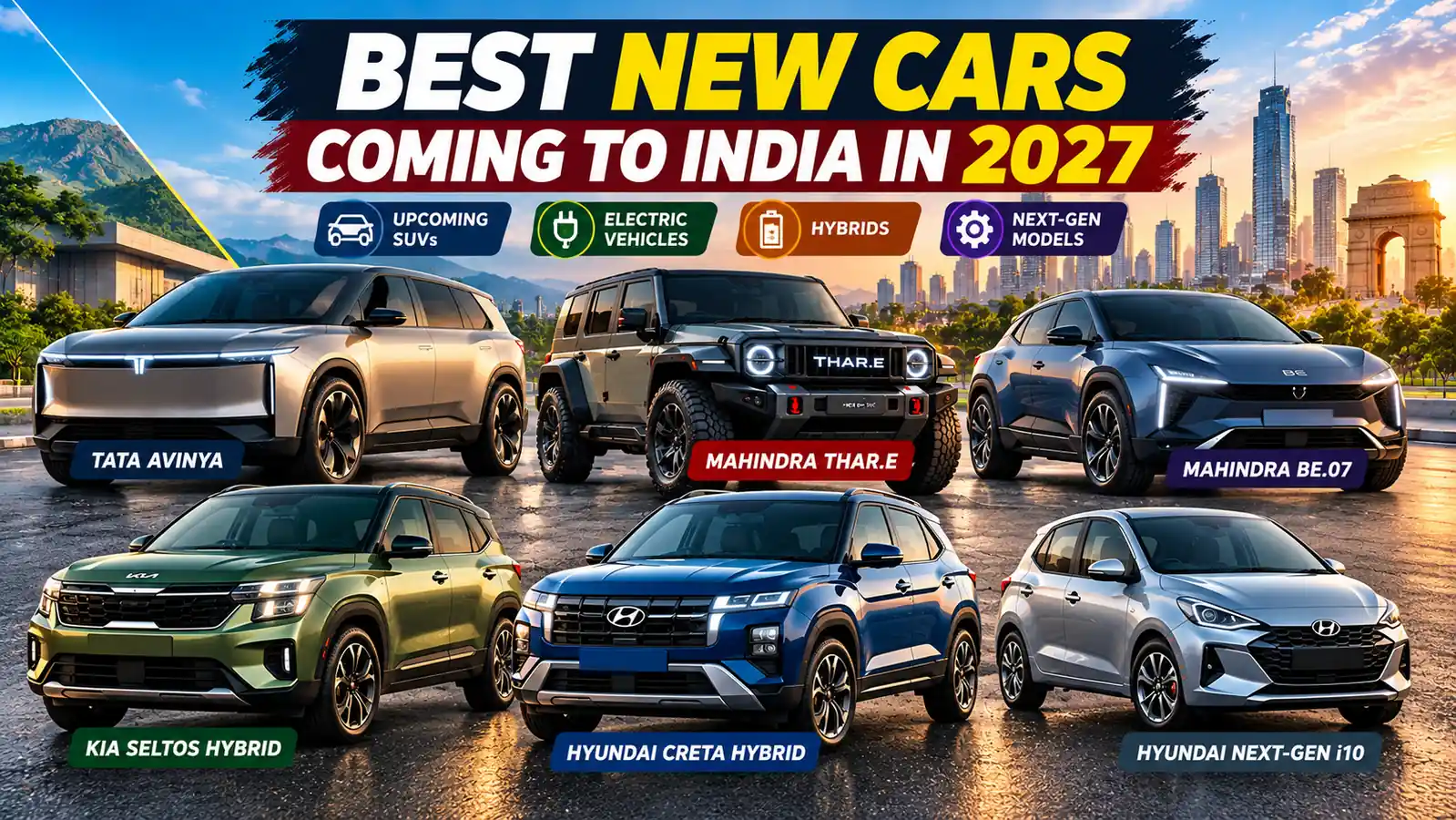
The Indian car market is expected to see several important new launches in 2027, with electric vehicles, hybrid SUVs and next-generation models likely to give buyers more choices.
Several manufacturers are working on new products for India, including Tata Motors, Mahindra, Hyundai and Kia. However, launch dates, prices and specifications can change, especially when a model is still under development.
In this guide, we look at some of the most interesting new cars expected in India around 2027, what is currently known about them and what buyers should consider before waiting for an upcoming model.
Important: Upcoming-car information can change before launch. Expected prices, specifications and timelines should not be treated as final unless officially confirmed by the manufacturer.
The 2027 Cars Worth Watching
| Upcoming Car | Powertrain | What Makes It Interesting |
|---|---|---|
| Tata Avinya | Electric | Premium EV based on Tata’s next-generation EV strategy |
| Mahindra Thar.e | Electric | Rugged electric SUV with an off-road focus |
| Mahindra BE.07 | Electric | Premium electric SUV from Mahindra’s BE family |
| Kia Seltos Hybrid | Strong Hybrid | Hybrid option for the popular midsize SUV |
| Hyundai Next-Generation Creta | Petrol/Hybrid/Diesel expected | Major generational update with new technology |
| Hyundai Next-Generation i10 | Petrol/CNG expected | New-generation small hatchback |
| Renault New Compact SUV | Petrol/Hybrid/EV options under consideration | Potential new entry in the compact SUV segment |
1. Tata Avinya
The Tata Avinya is one of the most ambitious electric-vehicle projects from Tata Motors and remains one of the most interesting upcoming premium EV programmes for India.
Tata says the Avinya concept is based on its Gen 3 EV architecture and that the Avinya will be introduced to the market by 2027. The concept focuses on premium electric mobility, spacious interiors, advanced technology and a more software-focused ownership experience.
Tata’s original Avinya concept also highlighted very fast charging capability and a long-range focus. However, those concept-level figures should not be treated as final production specifications until Tata confirms them for the India-spec model.
Why the Avinya is worth watching
- Premium electric positioning
- Next-generation EV architecture
- Spacious cabin concept
- Advanced software and connectivity
- Fast-charging focus
- Potential long-distance EV capability
Best suited for: Buyers interested in a premium EV and willing to wait for Tata’s next-generation electric platform.
2. Mahindra Thar.e
The Mahindra Thar.e could take the familiar Thar name into the electric SUV era.
Mahindra’s Thar.e concept was designed around an electric off-road SUV theme, and current automotive industry listings continue to place the production model around 2027. The expected configuration includes a four-wheel-drive layout and a dual-motor electric setup, although final production specifications have not yet been confirmed by Mahindra.
The concept is particularly interesting because it combines an electric powertrain with the rugged character associated with the Thar name.
What could make it special?
- Fully electric powertrain
- Four-wheel-drive capability
- SUV-focused design
- High ground-clearance concept
- Off-road-oriented positioning
- Potential dual-motor setup
Best suited for: Buyers who want an electric SUV with a more rugged and adventure-focused character.
3. Mahindra BE.07
The Mahindra BE.07 is another important electric SUV from Mahindra’s dedicated BE family.
The BE.07 was originally announced as part of Mahindra’s INGLO-based electric SUV strategy. Current upcoming-car listings continue to track the model for 2027, although buyers should check Mahindra’s latest communication before treating the launch timing as final.
The BE.07 is expected to target buyers looking for a more premium electric SUV with modern design, technology and strong performance.
What could make the BE.07 interesting?
- Dedicated EV architecture
- Premium SUV positioning
- Futuristic design
- Spacious cabin
- Connected technology
- Strong electric performance
Best suited for: Buyers looking for a premium electric SUV rather than a conventional petrol or diesel model.
4. Kia Seltos Hybrid
The Kia Seltos Hybrid could become one of the most interesting hybrid SUV additions to India’s midsize SUV segment.
Kia showcased the India-bound Seltos Hybrid at the 2026 Paris Motor Show, and current industry reporting points to an India launch in 2027. Kia has also previously indicated a clear direction to introduce hybrid technology in the Seltos.
However, the exact India-spec powertrain, price and launch date should still be treated as subject to confirmation. Current reporting suggests the India model could use a locally adapted hybrid setup rather than simply copying the specifications of another market.
Why buyers may be interested
A strong hybrid can appeal to buyers who want better fuel efficiency without depending entirely on external charging infrastructure.
It could be particularly relevant for:
- Daily city driving
- Regular highway travel
- SUV buyers
- Buyers not ready to switch to a full EV
- People looking for improved fuel efficiency
Best suited for: Buyers who want an electrified SUV but prefer the convenience of a hybrid powertrain.
5. Hyundai Next-Generation Creta
The next-generation Hyundai Creta is expected to be one of Hyundai’s major India launches around 2027.
Hyundai has confirmed plans for a next-generation Creta for India. Industry reports indicate that the new model is expected to receive a major redesign and could introduce a strong-hybrid powertrain alongside petrol and diesel options.
The next-generation model is expected to bring a redesigned exterior and interior, updated technology and an expanded feature package. However, final India-specific specifications and pricing have not yet been confirmed.
What could change?
- New exterior design
- Updated interior
- New infotainment and connected technology
- More advanced safety and driver-assistance features
- Petrol and diesel options
- Potential strong-hybrid option
Best suited for: Buyers who want a popular midsize SUV but are not in a hurry to purchase their next car.
6. Hyundai Next-Generation i10
Hyundai is also preparing a next-generation i10 for India.
Hyundai confirmed plans for next-generation versions of the Creta and i10, while current industry reports expect the new i10 to arrive around late 2027. Details are still limited, so the final design, specifications and equipment should be confirmed closer to launch.
The new i10 is expected to continue focusing on the small-car segment, with petrol and CNG powertrains likely to remain important.
What could change?
- New exterior design
- Redesigned interior
- Updated technology
- Improved safety equipment
- Petrol and CNG options expected
- Manual and automatic options may continue
Best suited for: Buyers looking for a compact city car who can afford to wait for a new generation.
7. Renault’s Next Compact SUV
Renault is also planning to expand its Indian SUV range with another compact SUV.
Industry reporting indicates that Renault is developing a new sub-four-metre SUV for India, with petrol, hybrid, CNG and electric powertrains being considered. The model is expected around 2027, although the final name, specifications and powertrain combination are not yet confirmed.
The new model could give Renault another entry into one of India’s most competitive SUV segments.
Why it could be important
- Compact SUV format
- Potentially broad powertrain choice
- Focus on Indian market requirements
- Could sit below the Duster
- Potential hybrid and EV technology
Best suited for: Buyers interested in a compact SUV and willing to consider a newer alternative to established models.
Why 2027 Could Be Important for Indian Car Buyers
The biggest change may not simply be the number of new models. It could be the wider choice of powertrains.
Indian buyers are increasingly able to choose between:
- Petrol
- Diesel
- CNG
- Strong hybrid
- Fully electric
This gives buyers more flexibility depending on their driving pattern.
Someone who drives mostly in cities may prefer a hybrid or EV, while a buyer who regularly travels long distances may still prefer a petrol, diesel or hybrid vehicle depending on fuel availability and running costs.
EV vs Hybrid: Which Makes More Sense?
There is no single answer for every buyer.
An EV may make sense if:
- You have reliable home or workplace charging.
- Most of your driving is within the city.
- You want to reduce dependence on petrol or diesel.
- You are comfortable planning longer trips around charging stops.
A hybrid may make sense if:
- You frequently drive long distances.
- Charging access is limited.
- You want improved fuel efficiency.
- You prefer a petrol-based vehicle with electric assistance.
The right choice depends on your daily distance, charging access, fuel costs, ownership period and local driving conditions.
Should You Wait for a 2027 Car?
Waiting can be a good decision if your current car is reliable and you are specifically interested in a new technology or generation.
Waiting may make sense when:
- Your current car is working well.
- You do not urgently need a replacement.
- You want an EV or hybrid.
- You are interested in a specific upcoming model.
- Your preferred segment is about to receive major new products.
Buying an existing model may be better when:
- You need a car immediately.
- A current model already meets your requirements.
- The upcoming model has an uncertain timeline.
- You can get an attractive deal on an existing car.
- You prefer proven technology and an established service network.
The smartest approach is to compare an upcoming model with at least two existing alternatives before making a final decision.
What Should You Check Before Booking an Upcoming Car?
An upcoming car can look exciting on paper, but buyers should not make a decision based only on launch hype.
1. Final Price
Expected prices can change significantly before launch. Compare the final ex-showroom and on-road price once the manufacturer announces them.
2. Real-World Efficiency
For petrol and hybrid cars, do not rely only on claimed fuel-efficiency figures.
For EVs, compare claimed range with independent real-world tests when reliable data becomes available.
3. Charging Infrastructure
If you are considering an EV, check whether dependable charging is available at home, work and along the routes you regularly use.
4. Battery Warranty
For an EV or hybrid, check battery warranty coverage, exclusions and the manufacturer’s terms before buying.
5. Safety
Look at crash-test results, standard safety equipment, airbags, electronic stability control and available driver-assistance technology.
6. Service Network
A new technology is useful only when the manufacturer can support it properly.
Check service availability in your city and the expected maintenance requirements.
7. Resale Value
New powertrain technology can affect resale values differently from established petrol and diesel models.
Consider how long you plan to keep the vehicle.
8. First-Batch Ownership
If you are buying a completely new generation or technology, you may want to wait for early owner feedback before making a decision.
This can reveal real-world issues that are not obvious during a launch event or showroom visit.
Frequently Asked Questions
Which are the most interesting new cars coming to India in 2027?
Some of the most interesting models currently expected around 2027 include the Tata Avinya, Mahindra Thar.e, Mahindra BE.07, Kia Seltos Hybrid and next-generation Hyundai Creta. Hyundai’s next-generation i10 and Renault’s planned compact SUV are also worth watching.
Which upcoming cars in 2027 are expected to be electric?
The Tata Avinya, Mahindra Thar.e and Mahindra BE.07 are among the electric models worth watching. However, final launch schedules and production specifications can change before market introduction.
Is the Kia Seltos Hybrid coming to India?
The India-bound Seltos Hybrid has been showcased and current reporting points to an India launch in 2027. However, Kia has not yet confirmed every India-specific specification and the exact launch timing should be checked closer to the event.
Will the Hyundai Creta get a hybrid version?
The next-generation Creta is expected to receive a strong-hybrid option alongside other powertrains. The hybrid version has been widely reported for 2027, but final India-specific specifications and pricing should be confirmed by Hyundai.
Is the Tata Avinya launching in 2027?
Tata’s official Avinya information says the vehicle will be introduced to the market by 2027. The final production model, specifications and pricing should be confirmed by Tata closer to launch.
Should I buy an EV or hybrid in 2027?
It depends on your driving pattern. An EV can make sense if you have convenient charging access and mostly drive in areas with good charging coverage. A hybrid can be attractive if you want improved efficiency but still want the convenience of conventional refuelling.
Final Thoughts
2027 could be an important period for India’s automotive market, particularly as manufacturers expand their electric, hybrid and next-generation vehicle portfolios.
The Tata Avinya and Mahindra’s upcoming electric SUVs could bring more choices to the EV market, while the Kia Seltos Hybrid and next-generation Hyundai Creta could make hybrid technology more accessible to mainstream SUV buyers.
At the same time, upcoming models such as Hyundai’s next-generation i10 and Renault’s planned compact SUV could bring fresh competition to more affordable segments.
However, an expected launch is not the same as a confirmed launch. Prices, specifications, features and timelines can change.
The best approach is to follow official manufacturer announcements, compare upcoming models with existing alternatives and consider your total ownership requirements before deciding whether waiting is worthwhile.
Views: 0
Leave a Reply